Captain Sessle's murder and the framing of Doris Evans
Partners in CrimeCaptain Sessle’s murder and the framing of Doris Evans turn on the difference between a recognizable coat and the person presumed to be wearing it. The discovery of Sessle’s body on a golf-course tee, followed by Evans’s arrest, seemed to point toward a straightforward accusation. Tommy Beresford’s reconstruction instead makes the case a carefully staged substitution: the evidence used against Evans was real, but its meaning had been engineered by the murderer.
Discovery and the apparent case
Just over three weeks before Tommy recounted the case, two members of the Sunningdale Golf Links club found a man lying face down on the seventh tee. They recognized him as Captain Anthony Sessle, a familiar figure on the course who habitually wore a striking blue golf coat. At first, his death was attributed to a possible sudden illness; a doctor’s examination established that he had been murdered, and that he had been dead for at least twelve hours. The weapon was a woman’s hat pin, a detail that appeared to point toward a female assailant.
The last known sighting became a central part of the puzzle. Sessle had been playing with his friend and business partner Hollaby. During the round, he abruptly said that the light was too bad and left by a narrow footpath, a shortcut toward the road and his bungalow. Hollaby and two other players had also noticed him speaking to a tall woman in brown, but were too far away to see her face. They wondered what she had said to disturb him. After the three men returned to the clubhouse, Sessle’s household offered no immediate alarm: his servants were away in London for their customary Wednesday trip, while his wife was visiting elsewhere.
For a time the murder produced no clear motive or suspect. The woman in brown became the subject of speculation, while the police were criticized for their apparent inaction. A week after the killing, however, Doris Evans was arrested and charged. The case against her rested on a strand of fair hair in Sessle’s hand and threads of flame-coloured wool caught on a button of his blue coat, as well as reports that a young woman in a matching outfit had gone to Sessle’s house and later returned to the station in visible agitation.
Evans and the planted evidence
Evans was a typist. In her account, she had met a well-dressed man at a cinema who gave his name as Anthony and invited her to his bungalow at Sunningdale. She said she did not know he was married. Their visit was arranged for a Wednesday, when the household servants would be away and Sessle’s wife would be absent; she learned his full name and address only after accepting the invitation.
Evans said she arrived at the bungalow and found Sessle’s manner strange despite his apparent pleasure at seeing her. Tommy’s later reconstruction supplied the explanation: the man who had invited her and brought her to Sunningdale was, he argued, not Sessle but someone impersonating him. At the links, that man frightened Evans with a revolver and made her flee. In the ensuing struggle, her hair and coat wool could have been caught on the victim, leaving authentic traces that appeared to incriminate her without making her the killer.
Evans maintained her account consistently through the proceedings and denied using a hat pin against Sessle in self-defence. A revolver was found in the furze near the place where the body lay; it had not been fired. Although she was sent for trial, the evidence did not resolve the murder. If Evans’s story was true, someone else had killed Sessle, and the unknown woman in brown remained unexplained by the public version of events.
Tommy’s reconstruction
Tommy re-examined the sightings against his own knowledge of the course. He recalled playing the sixth hole at dusk, with Sessle and Hollaby ahead on the green, and seeing a woman on the footpath to his left. She had not crossed from the Ladies’ Course, which lay on the other side of the links and would have been visible to him. He also realized that he had not seen her earlier from the fifth tee. Behind the sixth tee stood a small turf shelter where a person could wait unseen and alter their appearance.
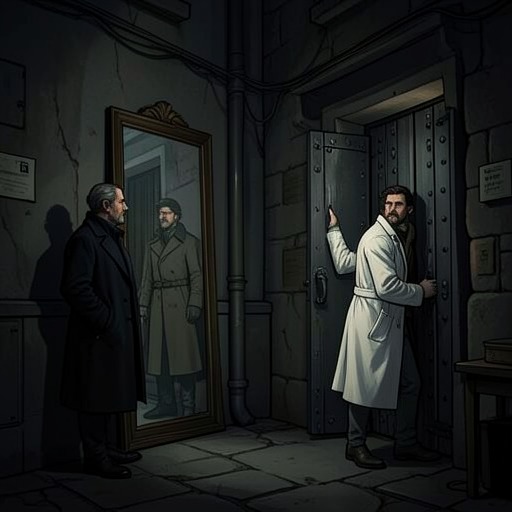
That observation suggested a disguise rather than a second, unidentified woman. Tommy proposed that a man could wear a skirt over plus-fours, then change back after the killing. Near the seventh tee, the footpath and thick furze offered both concealment and a place to hide the body. In his reconstruction, the disguised man approached Sessle, drew him out of sight, killed him with the hat pin, and placed the body in the bushes. He then removed Sessle’s blue coat and cap, discarded the skirt and disguise, and returned to the golfers wearing the familiar outfit. The players behind could recognize the coat without examining its wearer closely; their assumption that Sessle had rejoined them concealed the substitution. Their observation that the player’s golf was unlike Sessle’s became, in retrospect, a clue that the man was someone else.
Tommy extended the same logic to the accusation against Evans. The supposed Sessle had arranged for her to visit on the Wednesday when the house would be empty, then used the revolver to frighten her away from the links. Once she had fled, the murderer could bring the hidden body into view and leave the weapon behind as part of the scene. Tommy suggested that the murderer may have walked to Woking, several miles away, to return to town, but presented that route as a conjecture rather than an established fact.
Suspects, motive, and aftermath
The substitution depended on familiarity with Sessle’s routines and home, as well as the ability to imitate his appearance. Tommy reasoned that the murderer had to know that the servants were absent on Wednesdays and Sessle’s wife was away, and must have been able to obtain an impression of Sessle’s latchkey. He identified Hollaby’s son as a plausible suspect: he was approximately Sessle’s age and height, and both men were clean-shaven. In Tommy’s view, those similarities would have helped the disguise work.
The case also intersected with Tommy’s theory about the Porcupine Assurance Company. He believed Hollaby and his son were the real embezzlers and argued that the murder had confused an existing line of suspicion about the company’s figures. The theory explained why a person close to Sessle might have both the access and the knowledge needed to set the plot in motion. Tommy further observed that Hollaby’s son had never appeared in the proceedings; old Hollaby, with what Tommy described as an irreproachable alibi, had remained in public view, while nobody had apparently examined what his son was doing on the evening of the crime.
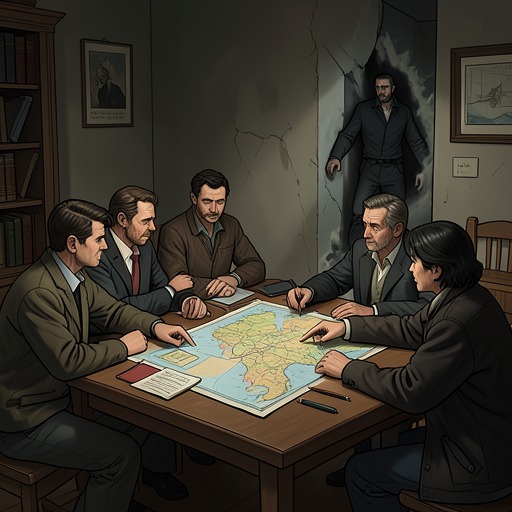
Inspector Marriot, who had been listening to Tommy and Tuppence Beresford, said that the police had already been dissatisfied with the Porcupine figures and suspicious of the Hollabys, but had lacked evidence. He agreed to confront the younger Hollaby with Evans and see whether she recognized him. The intended confrontation offered a practical test of Tommy’s reconstruction, while Marriot’s response connected the murder inquiry to the broader financial suspicions. The episode’s decisive reversal is that the clues against Evans need not be false to be misleading: her presence, the hair, and the wool could all be genuine, while the blue coat and the apparent return of Sessle supplied the disguise that made the framing possible.